Search everything — services, courses, dates, insights and case studies.
Crisis management exercising and testing
Preparation is the cornerstone of resilience.
In today's complex and unpredictable world, your organisation must be ready to respond swiftly and effectively to any disruption. At Oakwood Risk & Resilience, we believe that the best way to prepare is to test your plans and your people in realistic, challenging scenarios.
By the numbers
100+
Exercises delivered for boards, executive teams and operational leaders across critical sectors.
How We Work
Our Approach
We design exercises that go beyond simply ticking a box. Our testing and exercising programmes are built to challenge, develop, and strengthen the people responsible for leading in a crisis.
Tailored Scenarios
We design each exercise around your organisation, your risks, and your operating environment. There are no off-the-shelf scripts.
Experienced Facilitators
Our team brings a wealth of operational and crisis experience from backgrounds in the police, military, and other critical sectors.
Progressive Approach
From basic tabletop exercises to high-pressure simulations with media injects and role-players, we scale each exercise to match your maturity and objectives.
Constructive, Honest Feedback
We provide clear, actionable debriefs that highlight strengths, identify gaps, and recommend realistic next steps — not just technical observations.
Focus on Capability
Every exercise is an opportunity to build confidence, improve performance, and grow your organisation's resilience from the inside out.
Measurable Outcomes
Each engagement ends with clear benchmarks, documented learning points, and a practical roadmap so improvements are tracked, evidenced, and embedded long after the exercise ends.
“
Plans rarely fail on paper. They fail in the first thirty minutes — when ambiguity, time pressure and competing priorities collide. Exercising is how you find the cracks before a real incident does.
What We Offer
Our Services
We offer a range of testing and exercising services, tailored to meet the specific needs of your organisation.
01
Scenario-Based Exercises
We develop bespoke, realistic scenarios tailored to your business. Whether you're preparing for a data breach, natural disaster, or supply chain disruption, our immersive simulations provide a safe yet challenging environment to practice and refine your responses.
Learn 02
Live & Tabletop Exercises
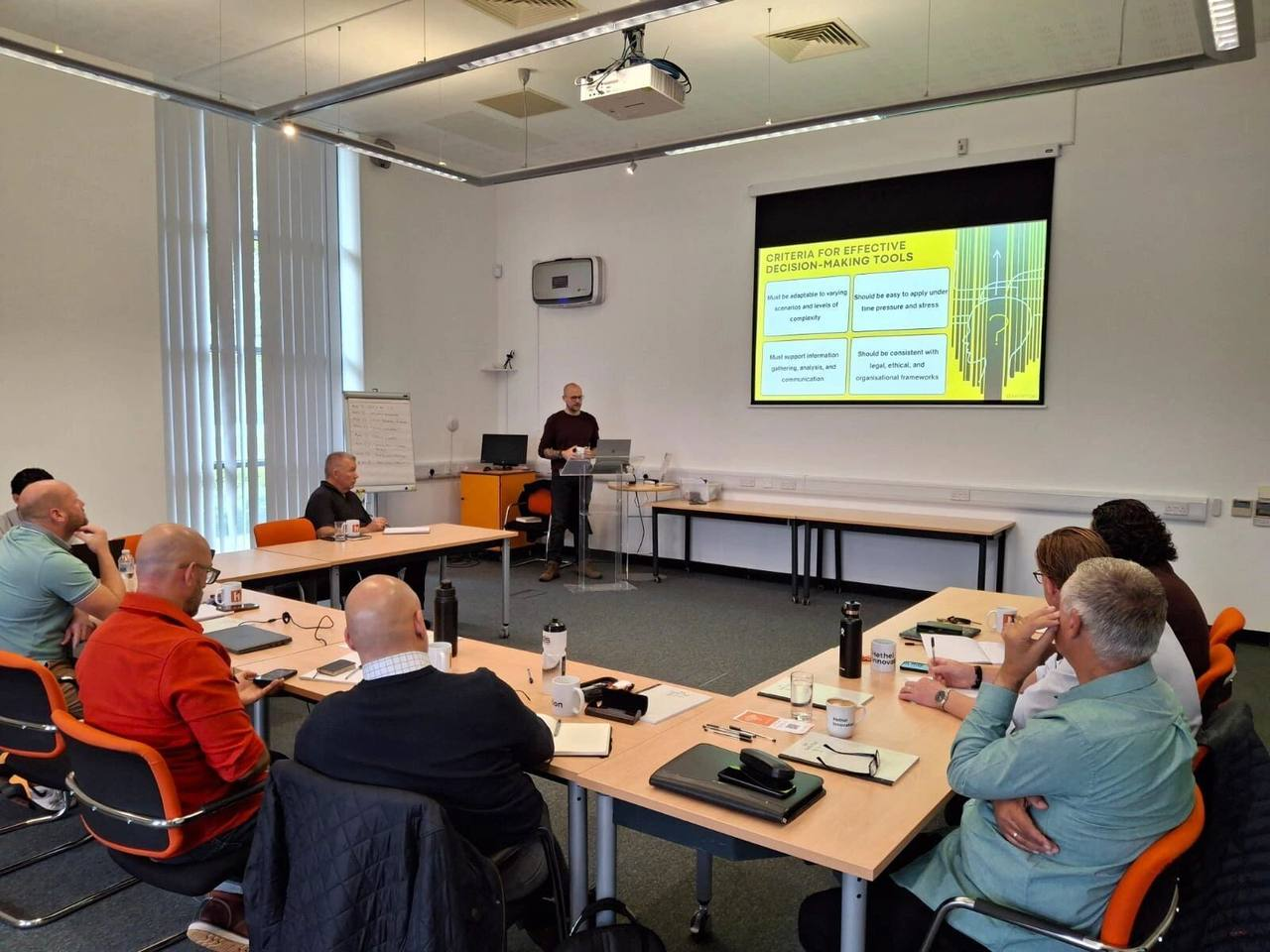
We offer a variety of exercise formats, from live drills to tabletop exercises, ensuring your team is ready for any situation. Our interactive sessions encourage collaboration, improve decision-making skills, and strengthen communication across all levels of your organisation.
Learn 03
Post-Exercise Review & Feedback
After every exercise, we conduct a thorough debrief, offering detailed feedback on performance, identifying gaps, and recommending improvements. This process ensures continuous development and enhances your organisation's resilience over time.
Learn
Whether you are preparing a leadership team for their first live incident or stress-testing a seasoned crisis management group, we create exercises that leave your people better equipped and ready to respond.
We design and run crisis management exercises that test your plans, your people and your decisions before a real incident does. That covers anything from a two-hour board tabletop to a full-day simulation with live media injects and role-players. We have delivered more than 100 exercises for boards and executive teams in critical sectors. Every exercise ends with a written report your auditors and regulators can rely on.
Types of exercise we run
Exercise
What it tests
Typical length
Best for
Tabletop (discussion-based)
Decision-making, roles, escalation
2 to 4 hours
Boards, new crisis teams, first test of a plan
Walkthrough
Whether a plan works step by step
2 to 3 hours
Newly written or updated plans
Simulation
Pressure, information flow, communications
Half day to full day
Established crisis and incident teams
Live exercise
Real-world response, logistics, multi-agency working
Full day
Sites, operations, emergency response
Notification test
Call cascades and mass notification tools
Under 1 hour
Any organisation, run several times a year
Exercise scenarios can include anything your organisation considers to be a plausible threat, including cyber security and ransomware, terrorism (including Martyn's Law linked exercises), insider threats, supply chain failure, health and safety, and climate change incidents.
How we design your exercise
Designing a good exercise is a lot like writing a story. Your people are the characters, your organisation is the setting, and the scenario is the plot. The injects are the twists that test each decision. Unlike most stories, the ending isn't written in advance, because your team decides how it ends. That's why the preparation matters as much as the day itself.
01
Scoping
1 to 2 weeks
We agree your objectives, who takes part, which plans and standards to test against (such as ISO 22361), and what success looks like.
02
Research
1 to 2 weeks
We review your crisis plans, team structure, risks and past incidents, and speak to the people who know them best.
03
Writing the scenario
2 to 3 weeks
We write the storyline and timeline, then build the injects: news reports, social media posts, emails, calls, messages and, where it fits, ransomware screens. Simulations are built into Crisis Room, the exercise environment Oakwood uses to deliver its own exercises.
04
Review and rehearsal
about 1 week
We take your exercise lead through the storyline in confidence, adjust it for realism, and test the Crisis Room set-up.
05
Exercise day
2 hours to a full day
An experienced facilitator runs the exercise, adjusting the pace live as your team responds.
06
Hot debrief
30 to 60 minutes, same day
We capture lessons straight away, while they're fresh.
07
Report
within 10 working days
You get findings, a prioritised action plan and evidence for audit.
From first conversation to exercise day usually takes 4 to 8 weeks. A simple tabletop can be quicker, and a multi-site simulation takes longer. Only your exercise lead sees the scenario in advance, so the rest of the team meets the story for the first time on the day.
Exercises run on Crisis Room
Our simulations run on Crisis Room, the exercise environment Oakwood built and uses to deliver its own sandbox environment that behaves like the real thing, with live social media feeds, emails, ransomware screens, mapping and live messaging. Your team sees the crisis unfold the way it would on the day, and has to decide and communicate under the same pressure, without any risk to your live systems or public channels. Facilitators can speed up, slow down or redirect the scenario in real time, depending on how your team responds. Every decision is logged, so the post-exercise report is built on evidence rather than memory. Teams can join from different offices and countries, which is how we ran the New York and London exercise described below.
Our exercises follow good practice in ISO 22301 (business continuity, including its exercise programme requirement), ISO 22361 (crisis management) and BS 11200. For financial services firms, we design scenario tests that support FCA and PRA operational resilience rules on important business services and impact tolerances, and DORA testing where it applies.
Who we work with
Boards and executive teams, crisis management teams, incident and business continuity teams, and site or operational teams. Sectors include financial services, higher education, student accommodation, property and critical national infrastructure.
Example: global investment organisation
A global investment organisation asked us to test how its crisis management team would handle a fast-moving reputational crisis across its New York and London offices. We designed a facilitated tabletop exercise around an incident that escalated through social media and public demonstrations, with simulated media and social media injects adding reputational, regulatory, operational and welfare pressure across both jurisdictions. We measured the response against ISO 22361 crisis management principles, observed decision-making and information flow between the offices, and ran a structured debrief.
Outcome: the organisation updated its crisis documentation, clarified roles across the crisis management team, tightened decision-logging, and went on to run further scenario testing across its regional offices. Read the case study.
A year of exercising with CrisisReady
CrisisReady™ is a 12-month programme across Foundation, Core and Advanced tiers that moves an organisation from a first tabletop to a full simulation.
FAQs
Crisis exercising FAQs
What is a crisis management exercise?
+
A planned rehearsal in which your team responds to a realistic scenario so that you can test your plans, roles and decision-making before a real crisis.
What's the difference between a tabletop exercise and a simulation?
+
A tabletop is a facilitated discussion around a scenario. A simulation runs in real time, with information arriving as injects, such as calls, emails and media, so the team has to act under pressure.
How often should we exercise our crisis plan?
+
At least once a year for the crisis team, and after any major change to the plan, people or structure. Many organisations test more often, for example once a quarter.
How long does it take to prepare an exercise?
+
From first conversation to exercise day usually takes 4 to 8 weeks. A simple tabletop can be quicker, and a multi-site simulation takes longer.
Can you run exercises online?
+
Yes. Tabletop and simulation exercises can run online or hybrid for teams spread across sites.
Do we get a report afterwards?
+
Yes. Every exercise includes a post-exercise report with findings and a prioritised action plan.
What is Crisis Room?
+
Crisis Room is Oakwood's own exercise platform. It runs simulations in a dedicated sandbox that mimics real life, with live social media feeds, emails, ransomware screens, mapping and live messaging, so your team can practise under realistic pressure without touching live systems.
Insights
Further reading.
Briefings, points of view and lessons learned from the team — selected for relevance to this service.