
Crisis Room · the exercise environment Oakwood runs its simulations on
A crisis exercise that feels like the real thing.
Crisis Room is the exercise environment we built to deliver our own interactive scenarios. Social media, emails, a ransomware negotiation, a live map and a decision log all run at once and react to what your team decides. It feels real. Nothing is.
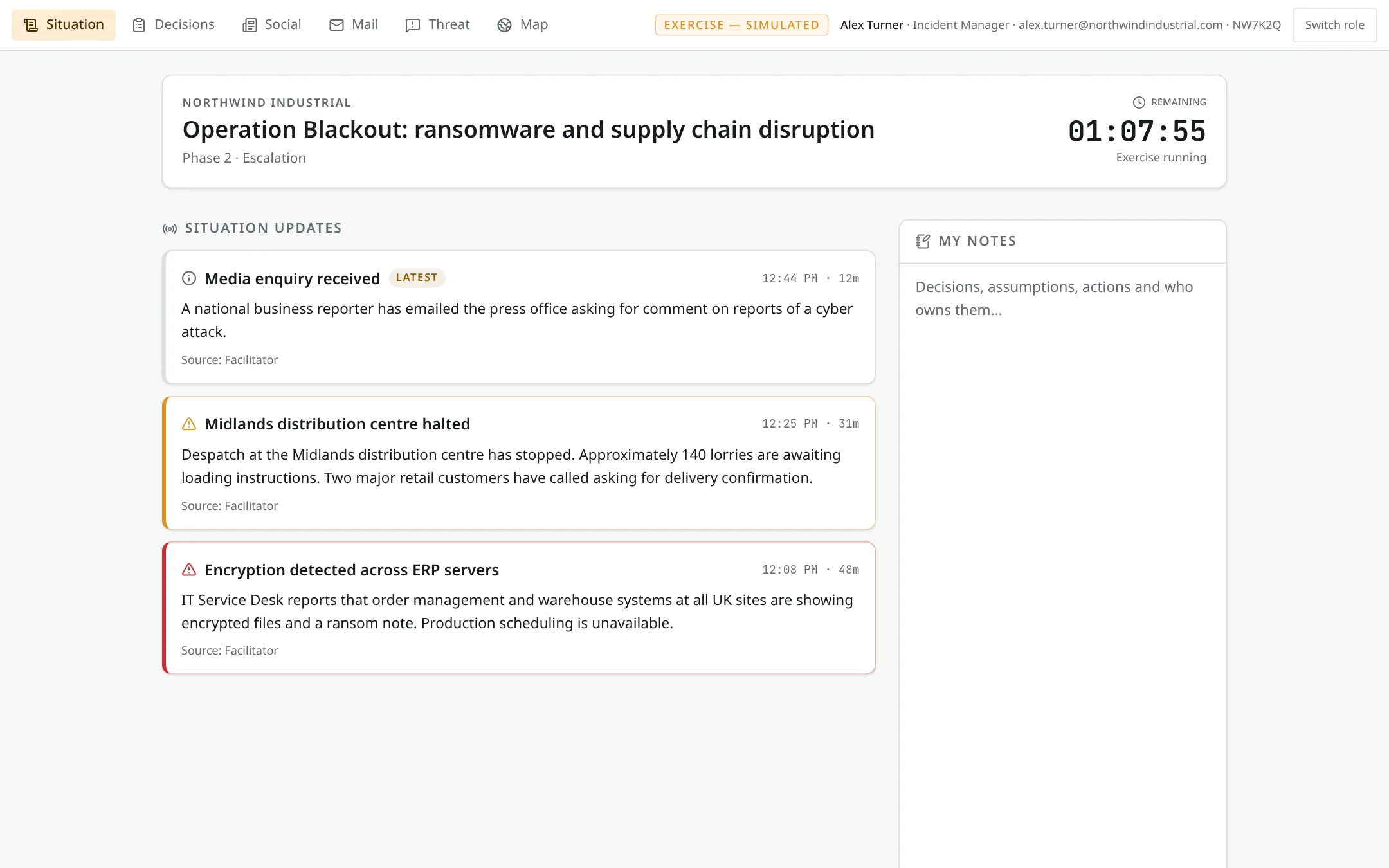
Screens show a fictional exercise for an example organisation.
Six screens, one exercise
Every channel a real crisis comes through.
01 / 06
One shared picture of the incident
Situation updates arrive graded as information, urgent or critical, against a visible exercise clock and the current phase. Each participant keeps private notes alongside the feed.
Why it matters
A slide deck tests what people say. Crisis Room tests what they do.
Injects read out from slides or paper
Information arrives across feeds, inboxes and chats at once, as it would on the day
The team discusses what it would do
The team acts. It replies, posts, negotiates and records decisions under the clock
Lessons rely on notes and memory
Decisions and activity are timestamped and exported for the report
Everyone in one room
Participants join in a browser from any office or country
What your team gets
Tested like the real thing. Reported like an audit.
A test that feels real
Written around your organisation
Built on your threat picture, plans, suppliers and sites, so the pressure lands where it would on the day.
Pressure from every direction
News, social media, email and an attacker who pushes back arrive at once, as they would in a real incident.
Paced to your team
The exercise speeds up when the team is sharp and holds when a hard call needs making.
Consequences that follow decisions
What your team chooses shapes what happens next, so choices are tested rather than discussed.
Easy for your people
Nothing to install
No procurement, IT ticket or firewall change. Participants join in a standard browser on a laptop or tablet.
Join from anywhere
Teams join from any office, country or home, so dispersed and hybrid teams exercise together.
Room for observers
The live picture can go on the wall so senior leaders and observers follow without interrupting.
Safe by design
Every screen is marked as an exercise. Nothing touches your live systems, public channels or accounts.
Results you can use
A record, not recollection
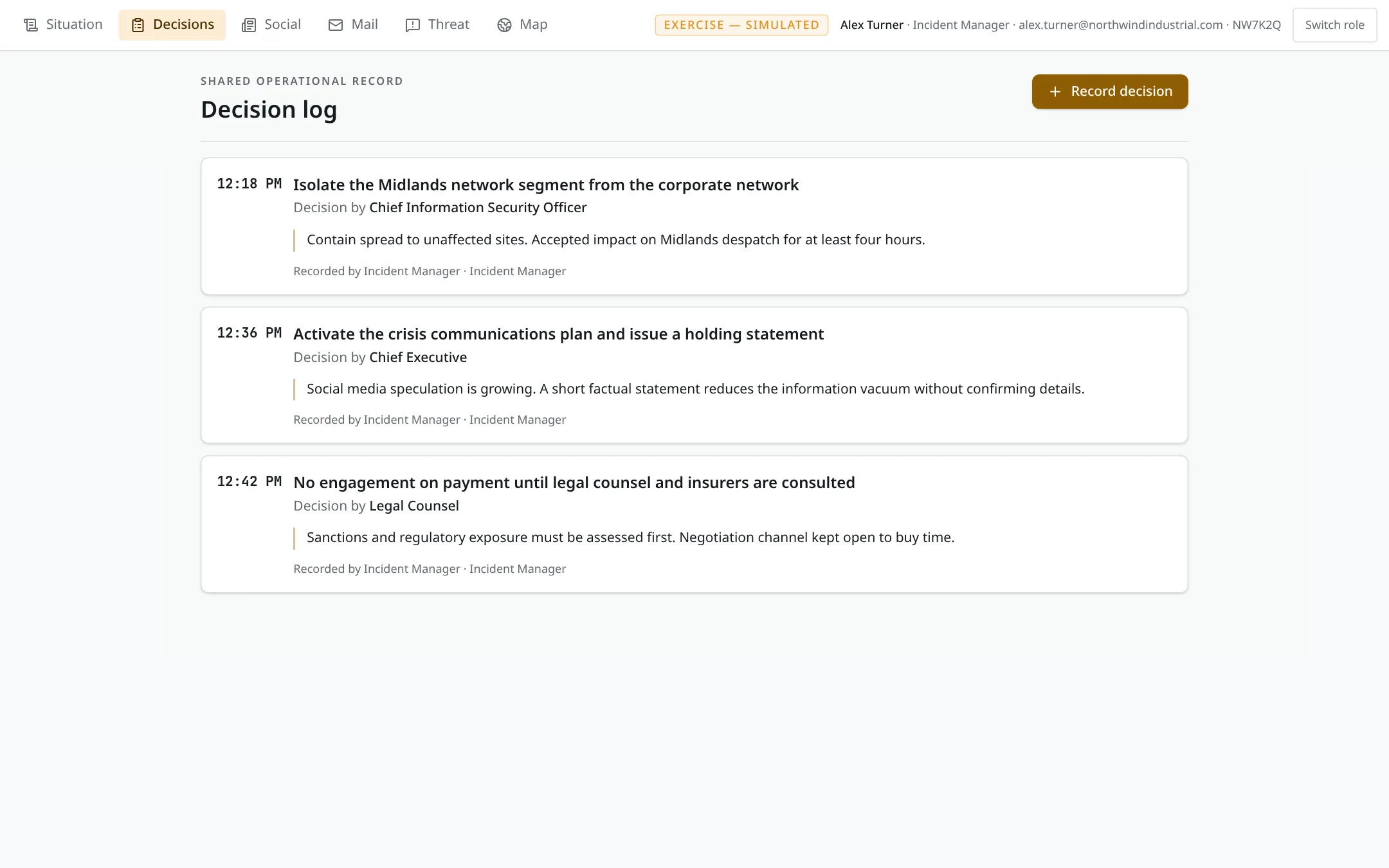
Decisions are logged with owner, time and rationale as they are made.
A report you can take to the board
A Word report and full timeline come out of the session, ready for the debrief and action plan.
Gaps found before they cost you
Weak plans, unclear roles and slow escalation show up in the exercise, not in a real incident.
Evidence for assurance
Supports exercising good practice in ISO 22301, ISO 22361 and BS 11200 and operational resilience scenario testing.
Evidence, not recollection
A debrief built on what actually happened.
Decisions are logged as they are made, with the owner and the rationale. Messages, replies and actions are timestamped. At the end you have a Word report and a timeline, so the hot debrief and the post-exercise report rest on the record rather than on memory.
That record supports exercising good practice in ISO 22301, ISO 22361 and BS 11200, and gives financial services firms evidence for operational resilience scenario testing.
Where it is used
Part of every Oakwood simulation.
Crisis Room is not sold or licensed as software and there is no public link to it. It exists for one purpose, which is to deliver the interactive scenario exercises Oakwood designs and facilitates, and it is included in every exercise we run.
Crisis management exercising
Tabletop, simulation and live exercises designed around your risks and plans.
Explore exercisingCrisisReady™ programme
A structured programme of training and exercising that builds capability over the year.
Explore CrisisReady™Crisis and incident training
Training for crisis teams before they are tested under pressure.
Explore trainingFAQs
Crisis Room questions
What is Crisis Room?
Crisis Room is the exercise environment Oakwood built to deliver its own interactive scenario exercises. It gives your team a closed, simulated environment with a situation feed, social media, a corporate mailbox, a threat actor channel, an operations map and a shared decision log, all reacting live to what your team decides.
Do participants need to install anything?
No. Participants join in a web browser on a laptop or tablet using an exercise code, then choose their name and role. Teams can join from different offices and countries.
Is anything sent to real systems or real social media?
No. Everything happens inside the simulated environment. No real systems are encrypted, no real posts are published and no payment is possible. Every screen is clearly marked as a simulated exercise.
Is the scenario pre-scripted?
The storyline and injects are prepared in advance with your exercise lead, then released as the session unfolds. The pace, the pressure and the direction change with how your team responds, so the exercise cannot be run from a script.
What evidence do we get afterwards?
Decisions are recorded in a shared log with the time, who made the decision and the rationale. You get a Word report and a timeline of the exercise, which feed the post-exercise report and action plan.
Can Crisis Room be used for a ransomware exercise?
Yes. The threat actor channel shows a ransom demand, a countdown to a data leak and a live negotiation chat with an attacker who pushes back on every reply you send. The countdown can be compressed to fit the session or run in real time.
Can we buy Crisis Room as software?
No. Crisis Room is not sold or licensed as software and there is no public link to it. It is the delivery environment Oakwood built and uses to run its own interactive scenario exercises, so it comes as part of an exercise we design and facilitate for you.
Book your team's next scenario exercise.
Tell us the disruption that would hurt your organisation most. We write the scenario around it, run it live on Crisis Room, and give you a debrief built on what your team actually did.
Book a scenario exerciseCrisis Room is not available as software on its own. It is the environment we use to run your exercise.